Typhoon-Powered Turbine: Japan's Answer to Clean Energy?
Tokyo, Japan — In the wake of the 2011 Fukushima disaster, a Japanese engineer has developed a wind turbine that not only survives typhoons but also captures their immense energy, potentially powering the country for half a century. Atsushi Shimizu, the inventor, claims that a single typhoon carries enough energy to meet Japan's electricity needs for 50 years if fully harnessed.
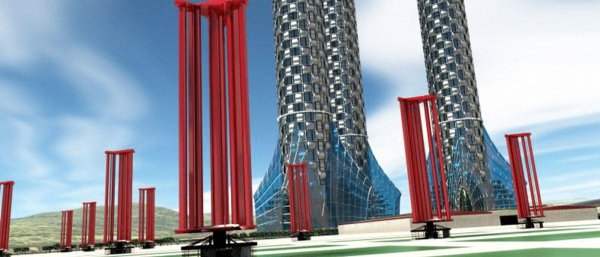
Shimizu's design, which resembles an eggbeater, employs the Magnus effect to stabilize the turbine against unpredictable wind directions and prevent it from spinning out of control. This is a critical improvement over conventional European-style turbines, which Shimizu says were not designed for typhoon zones and have largely broken in Japan.
“For decades, Japan has brought in European-style wind turbines, not designed for typhoon zones, and installed them with no careful consideration—they’ve broken almost entirely,” Shimizu told CNN. The new turbine aims to change that, offering a resilient alternative that leverages the very storms that have historically caused devastation.
The potential of typhoon energy is staggering. Estimates suggest that the energy from a single typhoon is equivalent to half of the world's electrical generating capacity. While capturing all of that energy is a monumental challenge, Shimizu's turbine represents a significant step toward tapping into this untapped resource.
Why Typhoon Energy Matters
Japan is regularly battered by typhoons, and this technology could transform a natural hazard into a renewable energy source. Given the global climate crisis, the need to move away from fossil fuels is urgent. Harnessing the power of Mother Nature, as Shimizu proposes, could help mitigate the effects of climate change and reduce reliance on nuclear power, which remains controversial after Fukushima.
Beyond immediate energy needs, Shimizu's work aligns with the broader goal of advancing human civilization. On the Kardashev scale, a Type I civilization would be able to control and utilize the elements—sunlight, volcanoes, earthquakes, and typhoons. This turbine could be a stepping stone toward that future, moving humanity beyond its current Type 0 status.
While the technology is still in its early stages, it builds on existing structures that already withstand hurricane-force winds. The question is whether such turbines can be deployed on a large scale and integrated into Japan's energy grid. Shimizu's innovation offers a glimmer of hope for a country that has long struggled to balance energy security with environmental sustainability.
As the world watches, Japan's experiment with typhoon-powered turbines could set a precedent for other storm-prone nations. The idea of turning a destructive force into a clean energy source is not just a technical challenge—it's a paradigm shift in how we think about renewable energy.
Typhoon-Powered Turbine: Japan's Answer to Clean Energy?
A Japanese engineer has developed a wind turbine designed to withstand typhoons and convert their immense energy into electricity. The technology could potentially power Japan for decades, offering a new approach to renewable energy in storm-prone regions.
Leave a Comment
Comments (0)