Metal Foam Shows Promise for Safer Nuclear Waste Transport
RALEIGH, N.C. – A team of engineers at North Carolina State University has demonstrated that a lightweight composite metal foam can withstand extreme heat far more effectively than conventional steel, a finding that could reshape how hazardous materials are stored and shipped.
In controlled fire tests, a steel-based composite metal foam (CMF) took eight minutes to reach 800°C on its unexposed side, while a solid steel plate of identical thickness heated to that temperature in just four minutes. The foam also expanded 80 percent less than bulk steel when subjected to flames, according to the researchers.
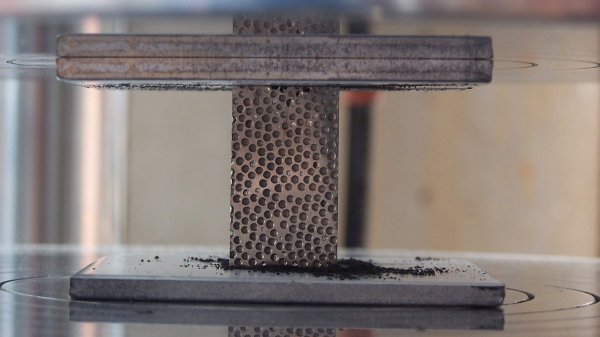
Composite metal foams are fabricated by embedding hollow metallic spheres—made from materials such as carbon steel, stainless steel, or titanium—within a metallic matrix, which can be aluminum, steel, or other alloys. Two manufacturing routes exist: casting a low-melting-point metal like aluminum around higher-melting-point spheres, or sintering a metal powder matrix around prefabricated hollow spheres. The latter method yields variants such as steel spheres in a steel matrix, which was the focus of the heat tests.
The research, led by Afsaneh Rabiei, a professor of mechanical and aerospace engineering at NC State, builds on earlier work showing that CMFs are exceptionally strong against high-velocity impacts and effective at blocking radiation. “We already knew the CMFs are lightweight materials with outstanding high-velocity impact resistance, and effective radiation shielding, now we know that it can withstand high heat,” Rabiei said in a statement.
That combination of properties makes CMF a candidate for containers used to transport and store nuclear waste, explosives, and other heat-sensitive materials. The material’s ability to slow heat transfer could provide an extra layer of protection in the event of a fire or accident, reducing the risk of thermal damage to the contents.
Beyond nuclear applications, the foam’s low weight and heat resistance could benefit space exploration, where every kilogram matters and thermal management is critical. In the biomedical field, CMF has been explored as a lighter alternative to solid titanium implants, potentially reducing stress on surrounding bone while maintaining structural integrity.
Why the Thermal Performance Matters
The fire test involved exposing one side of a steel-steel CMF sample to a flame for 30 minutes while monitoring the temperature on the opposite face. The eight-minute mark for reaching 800°C is significant because that temperature is often used as a benchmark for structural failure in metals. The slower heat rise gives responders and infrastructure more time before a container loses its integrity.
The reduced thermal expansion is equally important. When metals expand under heat, seals can break, and structural joints can weaken. An 80 percent reduction in expansion compared to bulk steel means CMF containers are less likely to deform during a fire, preserving their protective function.
Rabiei and her team have not yet published the full data set from this latest round of tests, but the results are detailed in a paper that has been submitted for peer review. The research was supported by the National Science Foundation and the Department of Energy, according to the university.
While the findings are promising, the researchers caution that further testing is needed before CMF can be deployed in real-world nuclear waste containers. Factors such as long-term durability, corrosion resistance, and manufacturing costs must be evaluated. Still, the combination of lightweight construction, impact resistance, radiation shielding, and now thermal insulation makes CMF a rare material that checks multiple safety boxes at once.
As the nuclear industry seeks to move waste to permanent repositories, the need for robust, fire-resistant casks is growing. CMF may offer a solution that is both lighter and safer than current designs, though it will likely take years of additional research and regulatory review before it appears in commercial use.
Metal Foam Shows Promise for Safer Nuclear Waste Transport
Researchers at North Carolina State University have found that composite metal foams can insulate against extreme heat far better than solid steel, potentially improving the safety of transporting nuclear materials and other hazardous cargo. The material also offers advantages in weight and expansion under fire, opening doors for applications from medical implants to space exploration.
Leave a Comment
Comments (0)