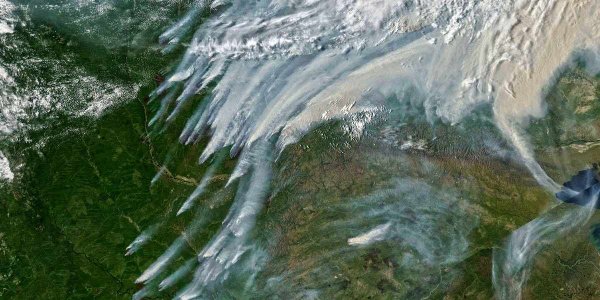
Siberian Wildfires Emit Unprecedented Carbon Levels in 2021
Wildfires raging across Siberia's Sakha Republic have pumped nearly 800 million metric tons of carbon dioxide into the atmosphere so far this year, a figure that already rivals the annual emissions of Germany and is nearly double the previous record set just last year, according to data from the Copernicus Atmospheric Monitoring Service (CAMS).
The 2021 fire season, which is still ongoing, has shattered records in the region, with CAMS estimating emissions at roughly 800 million metric tons of CO2—compared to 450 million metric tons for all of 2020. That earlier total had been the highest since CAMS began tracking fire emissions in 2003, said Mark Parrington, a senior scientist at the service.
“The increase in the total estimated fire emissions in the Sakha region has been almost double the total from last year – which itself was a record annual total in our fire emissions dataset, going back to 2003,” Parrington said in a statement.
The scale of the blazes has drawn international attention, with smoke plumes now traversing the Atlantic Ocean and reaching North America. More striking to researchers, large smoke columns have drifted directly over the North Pole—a phenomenon that, while not entirely unprecedented, has alarmed climate scientists, according to National Geographic.
Why the Smoke Reaching the Arctic Matters
The movement of smoke to the Arctic is more than a visual curiosity. As vegetation burns, it contributes to the degradation of permafrost—the permanently frozen soil that underlies much of the region. National Geographic reports that this loss of permafrost could lead to long-term damage, as the melting ice releases additional greenhouse gases and destabilizes the landscape.
Experts warn that the effects on global climate systems could be felt for decades, though the full extent of the damage may take years to assess. The immediate concern is the sheer volume of carbon being released, which adds to the atmospheric burden driving climate change.
The 2021 wildfire season has been exceptional not only in Siberia but globally, with fires occurring in diverse regions. However, the Sakha Republic's emissions stand out due to their magnitude and the region's role in global carbon cycling.
While the fires are a natural part of boreal forest ecology, their intensity and frequency have increased in recent years, a trend linked to rising temperatures and drier conditions—factors that climate scientists attribute to human-induced warming.
As the season continues, CAMS will keep monitoring emissions and smoke transport, providing data that helps researchers understand the long-term implications for the planet's climate.
Siberian Wildfires Emit Unprecedented Carbon Levels in 2021
Wildfires in Siberia's Sakha Republic have released nearly 800 million metric tons of CO2 in 2021, nearly double the previous record from 2020, according to the Copernicus Atmospheric Monitoring Service. The smoke has reached the North Pole, and melting permafrost could have long-term climate impacts.
Leave a Comment
Comments (0)