Antarctic Ice Emits Unexplained Radio Pulses, Baffling Physicists
Penn State University physicists, working with a balloon-borne cosmic particle detector in Antarctica, have recorded radio pulses that appear to emanate from beneath the ice—an observation that, according to the team, does not fit within existing particle physics frameworks. The signals, detected by the Antarctic Impulsive Transient Antenna (ANITA), were captured during a search for neutrinos, the elusive subatomic particles that rarely interact with matter.
The findings, published in the journal Physical Review Letters, describe radio waves arriving at unusually steep angles—roughly 30 degrees below the ice surface—rather than from the expected direction of space. Stephanie Wissel, an associate professor of physics and astronomy at Penn State and a member of the ANITA collaboration, acknowledged in a university statement that the team is at a loss to explain the phenomenon. “We still don’t actually have an explanation for what those anomalies are,” she said, “but what we do know is that they’re most likely not representing neutrinos.”
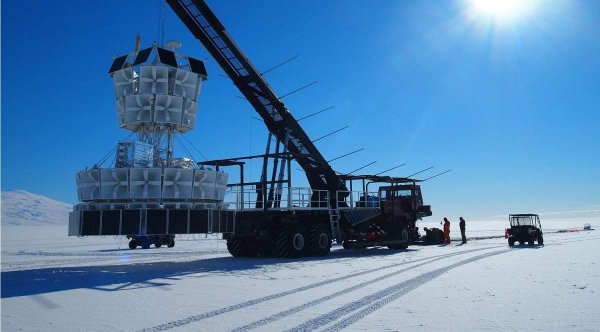
ANITA, a suite of instruments suspended from high-altitude balloons, typically detects particles that reflect off the ground after arriving from space. The new signals, however, seem to originate from below the horizon, a geometry that the researchers say is inconsistent with known particle interactions. The team had been hunting for neutrinos, which are abundant throughout the universe but are emitted by extreme sources such as supernovae and particle accelerators. Because neutrinos interact so weakly, they can travel vast distances without being deflected, offering a potential window into the most energetic events in the cosmos.
“You have a billion neutrinos passing through your thumbnail at any moment, but neutrinos don’t really interact,” Wissel explained. “So, this is the double-edged sword problem. If we detect them, it means they have traveled all this way without interacting with anything else. We could be detecting a neutrino coming from the edge of the observable universe.”
After cross-referencing the ANITA readings with data from other neutrino observatories, the team concluded that the anomalous signals are not consistent with neutrino detections. Wissel speculated that the pulses might result from an unknown radio propagation effect near the ice and the horizon, but she noted that the team has not yet identified such a mechanism. “My guess is that some interesting radio propagation effect occurs near ice and also near the horizon that I don’t fully understand, but we certainly explored several of those, and we haven’t been able to find any of those yet either,” she said. “So, right now, it’s one of these long-standing mysteries.”
Next-Generation Detector on the Horizon
As ANITA approaches its 20th year of operation, NASA and partner institutions are developing a successor instrument called the Payload for Ultrahigh Energy Observations (PUEO). Designed to be larger and more sensitive than ANITA, PUEO aims to capture more of these puzzling signals and, potentially, detect neutrinos directly. Wissel expressed optimism about the upcoming mission: “I’m excited that when we fly PUEO, we’ll have better sensitivity. In principle, we should pick up more anomalies, and maybe we’ll actually understand what they are. We also might detect neutrinos, which would in some ways be a lot more exciting.”
The Antarctic research continues to push the boundaries of particle physics, with each anomaly offering a chance to refine our understanding of the universe. For now, the mysterious pulses from the ice remain an open question, one that the scientific community hopes the next generation of instruments will help answer.
Antarctic Ice Emits Unexplained Radio Pulses, Baffling Physicists
Researchers at Penn State, using a balloon-borne detector in Antarctica, have captured radio signals that appear to originate from beneath the ice, defying current particle physics models. The team, which was searching for neutrinos, says the anomalous pulses are likely not neutrinos and remain unexplained, prompting plans for a more sensitive instrument to investigate further.
Leave a Comment
Comments (0)